


Choosing a clinic for wisdom tooth extraction in Singapore should be based on appropriate clinical assessment, the experience and qualifications relevant to the procedure, diagnostic facilities, treatment planning, post-operative care and the complexity of the wisdom tooth. The right clinic is not necessarily the one making the strongest promotional claim, but one that can properly diagnose the tooth and explain whether simple extraction, surgical removal or referral for specialist care is appropriate.
Wisdom teeth, also known as third molars, are the last permanent teeth located at the back of the mouth. Some erupt normally and remain healthy, while others become partially erupted, impacted, difficult to clean or associated with recurrent infection and damage to nearby structures.
Not every wisdom tooth needs to be removed, as a clinical examination and appropriate dental imaging help determine whether removal is indicated and how complex the procedure may be.
Factors such as the position of the tooth, its relationship to nearby anatomical structures, the clinician performing the procedure and the availability of appropriate follow-up care are more meaningful when assessing a dental clinic.
Key Takeaways
Wisdom tooth removal should be based on clinical need and appropriate assessment rather than the presence of a wisdom tooth alone.
Important points include:
- Not every wisdom tooth requires extraction.
- Impacted or partially erupted wisdom teeth may cause pain, infection or problems with neighbouring teeth.
- Dental X-rays help assess the tooth’s position and surrounding structures.
- CBCT imaging may be appropriate in selected complex cases but is not routinely required for everyone.
- Simple extraction and surgical extraction are different procedures.
- Dentists can perform appropriate wisdom tooth extractions within their training and competence.
- Complex cases may be referred to an oral and maxillofacial surgeon or another appropriately trained clinician.
- Local anaesthesia is commonly used for wisdom tooth removal.
- Post-operative care is important for reducing complications and supporting healing.
- Medisave eligibility depends on the procedure and applicable Singapore rules.
- Cost should be considered together with clinical complexity and what is included in the treatment plan.
A suitable clinic should be able to explain why extraction is recommended, how it will be performed and what patients should expect during recovery.
What Makes a Dental Clinic the Right Choice for Wisdom Tooth Extraction?
The right dental clinic for wisdom tooth extraction is one that can appropriately diagnose the problem, assess procedural complexity and provide or arrange suitable treatment and follow-up care.
Wisdom teeth vary considerably between patients. One person may have a fully erupted upper wisdom tooth that can be removed relatively straightforwardly, while another may have a deeply impacted lower third molar positioned close to important anatomical structures.
This means the same treatment approach is not appropriate for every case.
When evaluating a dental clinic, patients should consider several practical and clinical factors:
- Appropriate assessment before recommending extraction
- Access to suitable dental imaging
- Clear explanation of the procedure and alternatives
- Experience appropriate to the complexity of the case
- Ability to manage or refer to complex cases
- Clear post-operative instructions and follow-up arrangements
These considerations provide more useful information than relying solely on promotional descriptions of a clinic or dentist.
When Should Wisdom Teeth Be Removed?
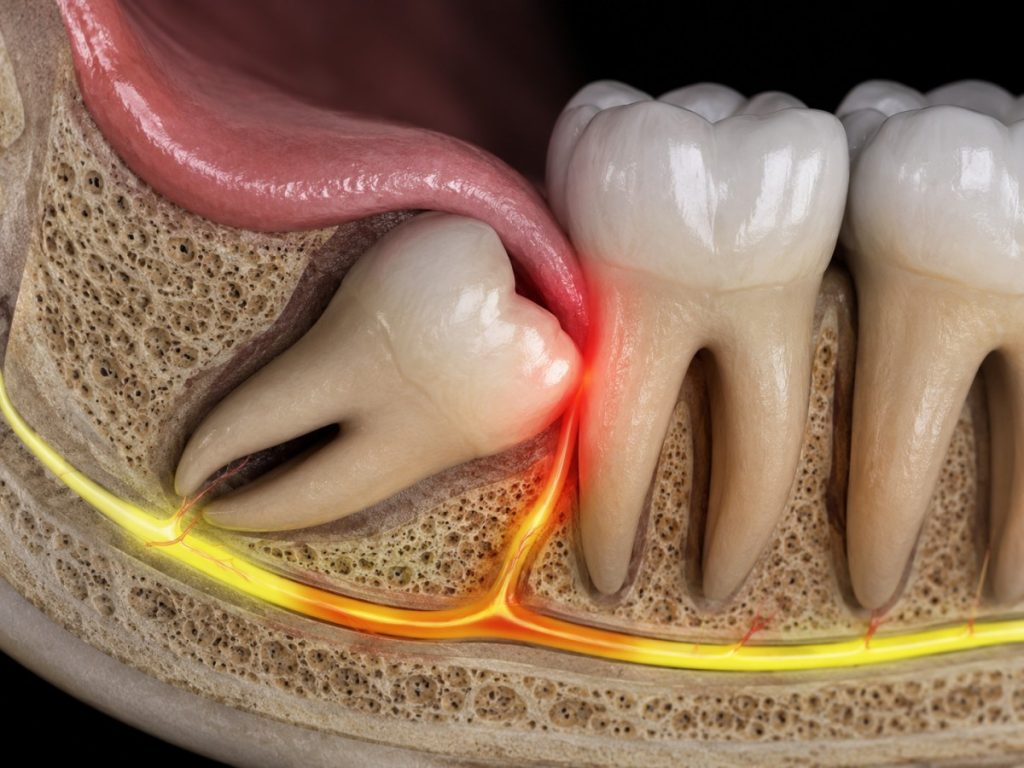
Wisdom teeth may need to be removed when they are causing disease, recurrent symptoms or a clinically significant risk to surrounding structures. Their presence alone does not automatically mean extraction is necessary.
A wisdom tooth can erupt normally and remain functional when there is sufficient space and it can be kept clean.
Problems are more likely when the tooth is impacted, only partially erupts or grows in an unfavourable direction.
Recurrent Wisdom Tooth Infection
Recurrent infection around a partially erupted wisdom tooth is a common reason removal may be considered.
When part of the tooth remains covered by gum tissue, food debris and bacteria can accumulate in areas that are difficult to clean.
Inflammation around a partially erupted wisdom tooth is commonly referred to as pericoronitis.
Symptoms can include pain, swollen gums, tenderness and difficulty chewing near the affected area.
Some episodes may initially settle with local treatment, but repeated infection can indicate that the tooth’s position continues to create a problem.
The dentist can assess whether removal is appropriate based on the tooth’s position and history of symptoms.
Tooth Decay

Wisdom teeth can develop tooth decay when their position makes effective cleaning difficult.
A partially erupted or angled third molar may be challenging to reach with a toothbrush and interdental cleaning.
Decay can affect the wisdom tooth itself or, in some situations, the adjacent second molar.
When the wisdom tooth is severely decayed or difficult to restore predictably because of its position, extraction may be considered.
The condition of the neighbouring tooth should also be evaluated because preserving the second molar is an important part of treatment planning.
Gum Disease Around a Wisdom Tooth
Gum disease can develop around wisdom teeth when plaque repeatedly accumulates in difficult-to-clean areas.
Deep pockets can form around the back teeth, particularly where a wisdom tooth is partially erupted or positioned unfavourably.
This can affect the supporting tissues around the wisdom tooth and potentially the neighbouring molar.
Removal may be considered when the tooth contributes to persistent periodontal problems that cannot be predictably managed through cleaning and maintenance alone.
Impacted Wisdom Tooth
An impacted wisdom tooth is one that cannot erupt into a normal functional position because its path is obstructed or there is insufficient space.
Impaction can be partial or complete.
An impacted tooth may remain symptom-free, but some develop associated problems such as infection, decay, damage to a neighbouring tooth or other pathology.
The direction and depth of impaction influence the complexity of wisdom tooth surgery.
Dental imaging is therefore important before surgical removal.
Damage to the Adjacent Tooth
A wisdom tooth positioned against the second molar can sometimes contribute to problems involving the neighbouring tooth.
Depending on the position, plaque accumulation may increase the risk of decay or periodontal problems in the area between the teeth.
In some cases, the adjacent tooth can develop structural complications associated with the impacted wisdom tooth.
The decision to remove the third molar considers both the wisdom tooth and the long-term health of the neighbouring tooth.
Does Every Impacted Wisdom Tooth Need Removal?
No. An impacted wisdom tooth does not automatically require removal when it is symptom-free, free of disease and not creating a clinically significant problem.
The risks and benefits of intervention should be considered individually.
Some impacted teeth can be monitored through dental examinations and appropriate imaging.
The patient’s age, tooth position, oral hygiene, symptoms and surrounding structures can all influence management.
Preventive removal may be discussed in selected circumstances, but the recommendation should be based on individual clinical findings rather than a universal rule that all wisdom teeth must be extracted.
Simple vs Surgical Wisdom Tooth Extraction
Simple extraction and surgical wisdom tooth extraction differ primarily in the accessibility and position of the tooth.
A clinical examination and dental imaging help determine which approach is likely to be required.
| Factor | Simple Extraction | Surgical Extraction |
| Typical tooth position | Fully or substantially erupted | Impacted or difficult to access |
| Gum incision | Usually not required | May be required |
| Bone removal | Usually not required | May sometimes be required |
| Tooth sectioning | Less commonly needed | May be required |
| Procedure complexity | Generally lower | Depends on impaction |
| Recovery | Often relatively straightforward | May involve more swelling and discomfort |
The exact procedure varies from patient to patient, even within these broad categories.
What Is a Simple Wisdom Tooth Extraction?
A simple wisdom tooth extraction generally involves removing an erupted tooth that can be adequately accessed without a surgical approach.
After local anaesthesia is administered, dental instruments are used to loosen and remove the tooth.
The procedure may be suitable when enough of the crown is visible and the tooth’s roots and position allow conventional extraction.
Even apparently straightforward extractions require assessment beforehand.
Root shape, tooth condition and surrounding anatomy can affect the procedure.
What Is Wisdom Tooth Surgery?

Wisdom tooth surgery is a surgical extraction used when a tooth cannot be removed predictably through a straightforward extraction technique.
This commonly applies to impacted third molars.
After local anaesthesia, an incision may be made in the gum to access the tooth.
A limited amount of surrounding bone may need to be removed, depending on the position of the tooth.
The wisdom tooth may also be divided into smaller sections so it can be removed with less unnecessary force on surrounding structures.
The site is cleaned after removal and may be closed with sutures.
The exact surgical technique depends on the tooth’s anatomy and relationship with surrounding structures.
Who Performs Wisdom Tooth Surgery?
Wisdom tooth surgery may be performed by a dentist with appropriate training and competence or by an oral and maxillofacial surgeon, depending on the complexity of the case.
Not every wisdom tooth extraction requires specialist treatment.
General dentists routinely perform dental extractions, including selected wisdom tooth removals, when the procedure falls within their training and clinical experience.
Complex cases may warrant referral.
An oral and maxillofacial surgeon is a dental specialist trained in surgical conditions affecting the mouth, jaws and related facial structures.
Factors that may influence referral include difficult impaction, unusual anatomy, proximity to important structures, significant medical considerations or anticipated surgical complexity.
In Singapore, patients can verify whether a practitioner is registered and whether a dentist is recognised in a particular dental specialty through the Singapore Dental Council.
What Is an Oral Surgeon?
An oral and maxillofacial surgeon is a dental specialist whose training includes surgical management of conditions involving the teeth, mouth, jaws and related structures.
Wisdom tooth surgery forms part of oral surgery practice, but oral surgeons also manage a broader range of conditions.
Seeing a specialist is not automatically necessary for every wisdom tooth.
The appropriate clinician depends on procedural complexity and individual risk factors.
A clinic should be able to explain who will perform the extraction and why that clinician is appropriate for the particular case.
Technology That Ensures Treatment Planning

Dental technology supports diagnosis and treatment planning for wisdom tooth extraction, but technology should be used according to clinical need.
Imaging is particularly important because parts of an impacted tooth cannot be assessed through visual examination alone.
The objective is to understand the tooth’s position, root anatomy and relationship to surrounding structures before treatment.
Digital Dental X-Rays
Dental X-rays provide information about wisdom teeth and surrounding structures that cannot be obtained through direct visual examination alone.
For wisdom tooth assessment, imaging can help show:
- The angle and depth of the wisdom tooth
- Root shape and development
- The position of the neighbouring second molar
- Surrounding bone
- Relevant anatomical relationships
Different types of dental radiographs may be used depending on the information required.
The dentist should select imaging that provides clinically useful information while following appropriate radiation protection principles.
CBCT Scan
A cone beam computed tomography or CBCT scan creates three-dimensional images of dental and surrounding anatomical structures.
CBCT is not automatically necessary before every wisdom tooth extraction.
It may be useful in selected cases when conventional imaging does not provide sufficient information for treatment planning.
For example, a clinician may consider CBCT when the relationship between a lower wisdom tooth and nearby anatomical structures requires further assessment.
Because CBCT involves additional radiation exposure compared with conventional dental radiography, its use should be clinically justified rather than routine.
Modern Surgical Techniques
Modern wisdom tooth surgery focuses on controlled access to the impacted tooth while limiting unnecessary trauma to surrounding tissues.
The exact technique is determined by the tooth’s position.
A surgeon or dentist may section the tooth into smaller portions rather than attempting to remove it as a single unit.
This can allow individual sections to be removed in a controlled manner.
The procedure may also involve careful bone removal where necessary to gain appropriate access.
No surgical technique completely eliminates post-operative discomfort or complications.
The objective is to perform the procedure appropriately according to the anatomy and complexity of the tooth.
What to Expect Before Wisdom Tooth Extraction
Before wisdom tooth extraction, the dentist evaluates the tooth, reviews relevant medical information and explains the proposed procedure.
Patients should provide an accurate medical history, including current medications, allergies and relevant health conditions.
The dentist may examine the gums around the wisdom tooth, check the neighbouring teeth and review appropriate imaging.
The discussion should cover:
- Why removal is being recommended
- Whether extraction is simple or surgical
- The type of anaesthesia planned
- Relevant risks and possible complications
- Expected recovery and post-operative care
- Available alternatives when applicable
Patients should have an opportunity to ask questions before giving informed consent for treatment.
What Happens During Wisdom Tooth Extraction?
Wisdom tooth extraction begins with anaesthesia to control pain during the procedure.
Local anaesthesia is commonly used.
The patient may still feel pressure or movement even when the area is adequately numb, but sharp pain should be communicated to the clinician.
For a simple extraction, the tooth is loosened and removed using appropriate instruments.
For surgical extraction, the dentist or oral surgeon may create access through the gum, remove a limited amount of bone and section the tooth when required.
Once the tooth has been removed, the socket is inspected and cleaned as appropriate.
Sutures may be placed following surgical extraction.
The patient then receives post-operative instructions before leaving the clinic.
Is Sedation Required for Wisdom Tooth Surgery?
Sedation is not automatically required for wisdom tooth surgery. Many procedures are performed under local anaesthesia alone.
Sedation may be considered in selected situations based on the patient’s needs, treatment complexity, anxiety level and clinical setting.
Sedation and local anaesthesia serve different purposes.
Local anaesthesia numbs the treatment area, while sedation is used to reduce awareness or anxiety to varying degrees depending on the method.
Patients who are concerned about dental anxiety should discuss available options with the clinic before the procedure.
The suitability of sedation requires individual assessment and appropriate safety considerations.
What to Expect After Wisdom Tooth Removal
Recovery after wisdom tooth removal commonly involves temporary discomfort, swelling and some limitation in jaw movement, particularly after surgical extraction.
The extent of these symptoms varies according to procedural complexity and individual healing.
Some bleeding or oozing can occur initially.
Patients are usually advised to follow specific instructions regarding pressure on the extraction site, eating, oral hygiene and medication.
Swelling commonly develops during the early recovery period and then gradually improves.
Pain should generally become more manageable as healing progresses.
Worsening symptoms after an initial period of improvement may require reassessment.
Wisdom Tooth Recovery Timeline
Wisdom tooth recovery occurs progressively rather than being completed on a single day.
During the first day, the priority is protecting the blood clot that forms in the extraction socket and controlling expected bleeding.
Over the following few days, swelling and discomfort may be present, particularly after surgical removal.
Patients can gradually return to normal eating as comfort allows, while avoiding activities or foods that may disrupt the surgical site.
Soft tissue healing continues after the initial symptoms have improved.
The extraction socket itself takes longer to remodel and heal completely.
The clinician’s post-operative instructions should take priority because recovery varies with the procedure performed.
What Is a Dry Socket?
Dry socket is a post-extraction complication in which the normal blood clot in the socket is lost or disrupted, leaving underlying tissues exposed.
It is also known as alveolar osteitis.
Dry socket commonly causes significant pain that develops or intensifies after extraction rather than gradually improving as expected.
The pain can sometimes radiate towards the ear or surrounding area.
Professional treatment may involve cleaning the socket and using appropriate measures to manage symptoms while healing continues.
Patients should contact their dental clinic if pain becomes significantly worse several days after extraction.
Other Possible Complications
Wisdom tooth extraction is commonly performed, but complications can occur as with other dental surgical procedures.
Possible complications vary according to tooth position and patient factors.
They can include infection, prolonged bleeding, delayed healing, damage to adjacent structures and sensory changes where relevant nerves are involved.
The specific risks should be explained according to the patient’s anatomy and procedure.
This is one reason pre-operative imaging and individual risk assessment are important.
Patients should understand both the expected recovery and symptoms that warrant contacting the clinic.
Post-Operative Care After Wisdom Tooth Surgery
Post-operative care supports normal healing and reduces avoidable disruption of the extraction site.
Patients should follow the specific instructions provided by their treating clinician.
General measures may include:
- Apply pressure with gauze as instructed for initial bleeding.
- Avoid unnecessarily disturbing the extraction socket.
- Choose foods that can be eaten comfortably during early recovery.
- Maintain oral hygiene while cleaning carefully around the surgical area.
- Take prescribed or recommended medication according to instructions.
- Contact the clinic if symptoms become severe or unexpectedly worsen.
Smoking and other behaviours that interfere with normal healing should be discussed with the treating clinician.
How Much Does Wisdom Tooth Extraction Cost in Singapore?
The cost of wisdom tooth extraction in Singapore varies according to whether the tooth requires simple or surgical removal, procedural complexity, diagnostic imaging, clinician involvement and other treatment requirements.
A fully erupted tooth that can be removed through simple extraction generally involves a different procedure from a deeply impacted lower wisdom tooth requiring surgical access and tooth sectioning.
For this reason, comparing only a single advertised extraction price may not provide a meaningful comparison between clinics.
A treatment quotation should clarify what is included.
Relevant components can include consultation, imaging, extraction or surgery, medication where required and follow-up care.
Patients should request a personalised treatment plan after assessment rather than assuming that a general price applies to every wisdom tooth.
Why Wisdom Tooth Surgery Can Cost More Than Simple Extraction
Wisdom tooth surgery can involve additional clinical time, surgical procedures and treatment complexity compared with simple extraction.
An impacted tooth may require gum access, bone removal, sectioning of the tooth and suturing.
More detailed imaging may also be clinically appropriate in selected cases.
The clinician performing the procedure can also influence the treatment structure, particularly when specialist management is indicated.
Higher procedural complexity does not automatically mean that every surgical extraction requires the same resources.
The actual treatment should be determined from the individual tooth and its anatomy.
Can You Use Medisave for Wisdom Tooth Surgery?
Medisave may be usable for eligible surgical dental procedures in Singapore, subject to prevailing CPF rules, claim limits and patient eligibility.
The distinction between simple extraction and surgical removal is important.
Routine non-surgical dental treatment is generally different from eligible surgical procedures for Medisave purposes.
A wisdom tooth requiring surgical extraction may potentially fall within applicable Medisave arrangements when the required criteria are met.
However, patients should not assume that every wisdom tooth removal qualifies.
Eligibility and claimable amounts can depend on the procedure performed and current rules.
The clinic should explain the applicable claim process and provide information relevant to the proposed treatment. Current requirements should also be verified against official CPF guidance when planning treatment.
Should Medisave Eligibility Determine Where You Go?
Medisave eligibility can help with financial planning, but it should not be the main clinical criterion for choosing a wisdom tooth clinic.
The primary considerations should remain accurate diagnosis, appropriate treatment and suitability of the clinician for the procedure.
A clinic should be transparent about whether the proposed procedure is eligible for a Medisave claim and what portion remains payable by the patient.
Patients should also understand that being able to use Medisave does not indicate that one clinic provides clinically superior treatment to another.
Financing and clinical quality are separate considerations.
How to Choose a Wisdom Tooth Dentist in Singapore
Choosing a wisdom tooth dentist involves assessing whether the clinician has the appropriate training and experience for the complexity of the extraction.
A straightforward erupted tooth and a deeply impacted lower third molar do not necessarily require the same level of surgical management.
Patients can ask who will perform the procedure and whether referral may be recommended if unexpected complexity is identified.
Registration and recognised specialist status can be checked through the Singapore Dental Council where relevant.
However, credentials should be considered alongside diagnosis, communication, clinical planning and follow-up arrangements.
How to Evaluate Claims About the “Recommended Wisdom Tooth Extraction in Singapore”
Patient reviews may provide information about communication or service experience, but they cannot establish whether a particular clinician is the most appropriate choice for every surgical case.
More useful criteria include whether:
- The diagnosis is clearly explained
- Imaging is used appropriately
- Alternatives are discussed where applicable
- The clinician’s experience matches the complexity of the case
- Risks and recovery are explained before treatment
- Follow-up arrangements are clear
These factors allow patients to make a more informed comparison without relying on unsupported superiority claims.
Questions to Ask Before Choosing a Dental Clinic
Patients can ask focused questions to better understand how a clinic approaches wisdom tooth extraction.
Useful questions include:
- Why does this wisdom tooth need to be removed?
The clinic should be able to explain the clinical reason rather than recommending removal simply because the tooth exists. - Is this a simple or surgical extraction?
Understanding the expected procedure helps clarify complexity and recovery. - Who will perform the extraction?
Patients can ask whether treatment will be performed by a general dentist or specialist and why that clinician is appropriate. - What imaging is required?
The clinician should explain whether conventional dental X-rays are sufficient or whether additional imaging such as CBCT is justified. - What are the important risks in my case?
Risk discussions should relate to the patient’s actual tooth position and medical circumstances. - What should I expect during recovery?
Clear post-operative instructions help patients prepare for the days following treatment.
These questions provide practical information that is more meaningful than selecting a clinic based solely on advertising.
What Should a Clinic Explain Before Surgery?
Before wisdom tooth surgery, the clinic should provide enough information for the patient to understand the proposed procedure and make an informed decision.
This should include the diagnosis, reason for extraction and expected complexity.
Relevant alternatives should be discussed where appropriate.
The clinician should also explain important risks, expected recovery and post-operative instructions.
If specialist referral is recommended, the reason should be made clear.
Financial information should distinguish the treatment components and explain applicable payment or Medisave arrangements.
Patients should not feel that they need to understand every technical detail, but they should understand what treatment is being proposed and why.
Warning Signs When Choosing a Wisdom Tooth Clinic
A patient should be cautious when important clinical questions cannot be answered clearly or when treatment recommendations are made without adequate assessment.
For example, promising that a procedure will be completely painless or risk-free would not reflect the realities of dental surgery.
Similarly, advanced technology should not be presented as automatically necessary for every case.
CBCT can be useful, but routine use without clinical justification is not inherently better care.
Patients should also be cautious when the focus is exclusively on price without discussing whether the tooth requires simple or surgical extraction.
A responsible treatment plan should connect the diagnosis, procedure, risks and follow-up care.
When Should You Seek Urgent Care for a Wisdom Tooth?
A wisdom tooth problem may require prompt dental assessment when pain, infection or swelling becomes significant.
Recurrent discomfort around a partially erupted wisdom tooth can indicate inflammation or infection.
Urgent evaluation becomes particularly important when there is increasing facial swelling, severe pain, difficulty opening the mouth or worsening symptoms.
Swelling that affects breathing or swallowing requires emergency medical assessment rather than waiting for a routine dental appointment.
A wisdom tooth infection should not be managed solely by repeatedly suppressing symptoms without determining whether definitive treatment is needed.
Frequently Asked Questions (FAQs)
What is the difference between wisdom tooth extraction and wisdom tooth surgery?
Simple extraction generally involves removing a sufficiently erupted wisdom tooth without surgical access. Wisdom tooth surgery may involve an incision, limited bone removal and tooth sectioning when the tooth is impacted or otherwise difficult to remove.
Do all wisdom teeth need to be extracted?
No. Wisdom teeth that are healthy, functional and not causing disease may not require removal. The decision should be based on symptoms, tooth position and clinical findings.
Should I see a wisdom tooth specialist in Singapore?
Not every wisdom tooth requires specialist treatment. A general dentist can manage appropriate cases within their competence, while complex impactions or other higher-risk situations may warrant referral to an oral and maxillofacial surgeon.
How do I find a clinic providing reliable wisdom tooth extraction in Singapore?
Look for appropriate assessment, relevant clinician qualifications and experience, suitable imaging, clear risk explanations, transparent treatment planning and reliable post-operative care.
Is wisdom tooth surgery painful?
Local anaesthesia is used to control pain during the procedure. Patients may experience pressure or movement during treatment and temporary discomfort and swelling afterwards. The amount of post-operative discomfort varies with procedural complexity and individual healing.
Is a CBCT scan always required before wisdom tooth surgery?
No. CBCT is used selectively when three-dimensional information is clinically necessary for diagnosis or surgical planning. Conventional dental imaging may provide sufficient information in many cases.
How long does wisdom tooth extraction recovery take?
Initial discomfort and swelling usually improve progressively during early healing, but recovery varies according to the procedure and individual patient. Surgical extraction can require a longer recovery period than straightforward extraction.
What is an impacted wisdom tooth?
An impacted wisdom tooth is a third molar that cannot erupt normally because of its position, lack of space or obstruction. It can be partially or completely impacted.
Can an impacted wisdom tooth stay in place?
Yes, in selected cases. An asymptomatic impacted tooth without associated disease may sometimes be monitored rather than automatically removed. The appropriate approach depends on individual clinical findings.
Can I use Medisave for wisdom tooth extraction in Singapore?
Medisave may apply to eligible surgical dental procedures subject to prevailing rules and claim limits. Routine simple extraction should not automatically be assumed to qualify. Eligibility should be confirmed for the specific procedure.
Can I return to work immediately after wisdom tooth surgery?
This depends on the complexity of the extraction, the nature of the patient’s work and individual recovery. Some patients may need time to recover from swelling and discomfort following surgical removal.
What are the warning signs after wisdom tooth surgery?
Persistent heavy bleeding, worsening swelling, significant pain that increases after initially improving, fever or other concerning symptoms should be reported to the treating clinic. Difficulty breathing or swallowing requires emergency medical attention.
Choosing a Clinic Based on Clinical Need, Not Claims
Choosing a clinic for wisdom tooth extraction in Singapore involves more than finding the nearest provider or comparing advertised prices. The position of the wisdom tooth, complexity of the extraction, health of neighbouring structures and patient’s individual circumstances determine what treatment is appropriate.
Simple extractions may be manageable without surgical access, while impacted wisdom teeth can require surgery and more detailed planning. Dental X-rays are important for assessment, while CBCT may provide additional information in selected complex cases.
The clinician performing the procedure should have experience appropriate to the case and should be able to explain the diagnosis, treatment options, risks, recovery and post-operative care. When specialist management is appropriate, referral to an oral and maxillofacial surgeon may be considered.
Patients searching for the “wisdom tooth extraction in Singapore” can make a more meaningful decision by focusing on clinical assessment, practitioner suitability and clear communication rather than relying on a single marketing claim.
Make an Informed Decision About Your Wisdom Tooth Treatment
If you have wisdom tooth pain, recurrent swelling, an impacted third molar or have been advised to consider wisdom tooth removal, book a consultation with Dr. Seah’s Root Canal Clinic. A dental assessment can evaluate the position and condition of the wisdom tooth, determine whether extraction is indicated and explain whether simple removal, surgical extraction or referral for specialist management is appropriate.
