


Impacted wisdom teeth are third molars that cannot fully erupt into their normal position in the mouth because they are blocked, angled incorrectly or do not have enough space to emerge. An impacted wisdom tooth may remain completely beneath the gum or partially erupt, leaving part of the crown exposed.
Not every impacted wisdom tooth causes problems or requires removal. Some remain symptom-free and can be monitored, while others develop recurrent gum infection, tooth decay, pain, damage to a neighbouring tooth or other complications.
A dental examination and appropriate imaging can help determine the type of tooth impaction and whether observation or wisdom tooth extraction is appropriate. Surgical removal may be recommended when an impacted tooth is causing clinically significant problems or cannot be maintained predictably.
Key Takeaways
Impacted wisdom teeth vary considerably in their position, symptoms and treatment requirements. Important points include:
- An impacted wisdom tooth cannot fully erupt into a normal functional position.
- Impaction may be partial or complete.
- Some impacted wisdom teeth remain symptom-free.
- Partially erupted teeth can be difficult to clean and may develop gum inflammation or infection.
- Pain and swelling can occur when complications develop.
- Impacted wisdom teeth can sometimes contribute to decay or problems involving the neighbouring second molar.
- Dental X-rays are commonly used to evaluate tooth position and surrounding structures.
- CBCT may be considered in selected complex cases when three-dimensional information is clinically useful.
- Treatment can range from observation to surgical wisdom tooth extraction.
- Long-term monitoring is important when an impacted tooth is retained rather than removed.
The decision should be based on the individual tooth, surrounding structures and evidence of disease.
What Is an Impacted Wisdom Tooth?
An impacted wisdom tooth is a third molar that is unable to erupt fully into the mouth because its normal pathway is obstructed or insufficient space is available. Wisdom teeth are the last permanent molars and are positioned at the back of the upper and lower jaws.
Impaction can occur when the jaw does not provide enough space for the tooth or when the tooth develops at an angle that prevents normal eruption. A wisdom tooth can be:
- Completely impacted beneath the gum and sometimes bone.
- Partially impacted, with only part of the crown visible.
- Angled towards the tooth in front.
- Angled backwards.
- Positioned more horizontally within the jaw.
The position influences whether the tooth can be cleaned, whether it affects neighbouring structures and how complex removal may be.
Why Do Wisdom Teeth Become Impacted?
Wisdom teeth become impacted primarily because there is insufficient room or an unfavourable eruption path at the back of the jaw. Third molars develop after most of the other permanent teeth are already in position.
When adequate space is available, a wisdom tooth may erupt normally. If space is limited, the tooth can become trapped against the second molar, gum tissue or surrounding jawbone.
Its direction of development can also contribute. A wisdom tooth angled forwards may encounter the tooth immediately in front, while a horizontally positioned tooth may remain largely within the bone.
Impaction is therefore an anatomical condition rather than an infection. Problems develop when the position of the impacted tooth contributes to disease or makes the area difficult to maintain.
Partially Erupted vs Completely Impacted Wisdom Teeth
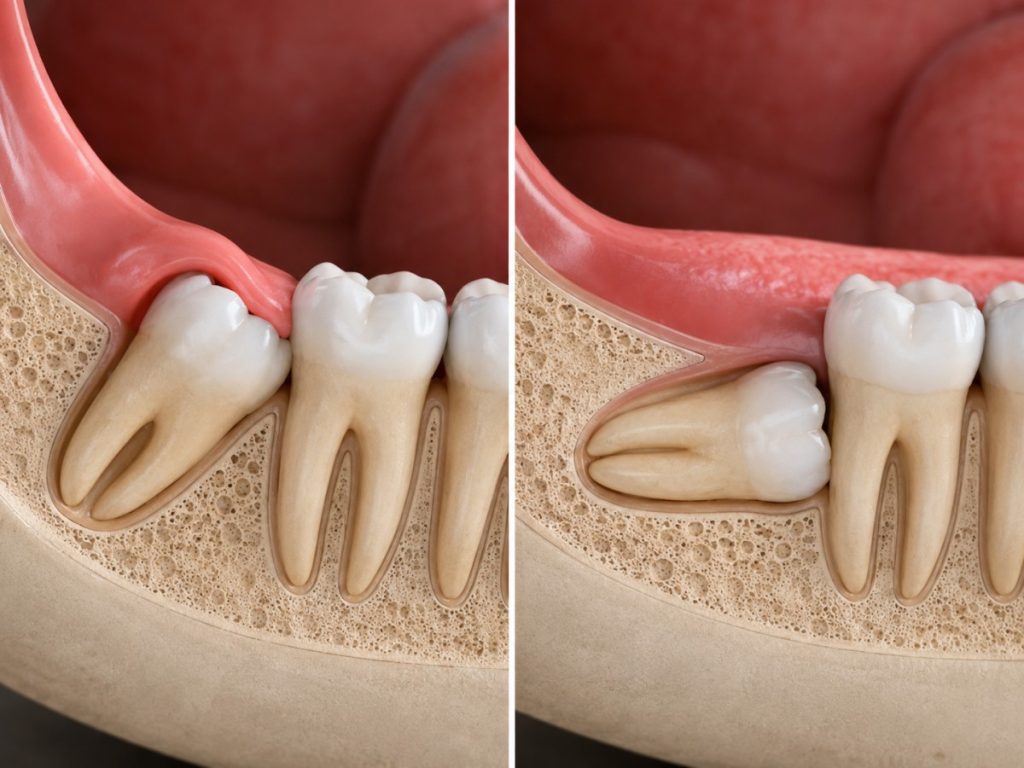
Partially erupted and completely impacted wisdom teeth differ according to whether any portion of the tooth has emerged through the gum.
Partially Erupted Wisdom Tooth
A partially erupted wisdom tooth has broken through the gum but has not fully entered the mouth. Part of the crown may remain covered by gum tissue. This can create a difficult-to-clean space where food debris and bacteria collect.
Partially erupted wisdom teeth can therefore be susceptible to recurrent gum inflammation, infection and tooth decay and can also contribute to problems affecting the adjacent tooth.
Completely Impacted Wisdom Tooth
A completely impacted wisdom tooth remains beneath the gum and may be partly or fully surrounded by the jawbone. Because it does not communicate directly with the mouth, it may not cause the same type of gum infection as a partially erupted tooth.
However, completely impacted teeth can still require monitoring for changes involving the tooth itself, adjacent structures or surrounding tissues. The absence of visible eruption does not establish that extraction is necessary.
Common Impacted Wisdom Teeth Symptoms
Impacted wisdom teeth may cause no symptoms at all. When symptoms develop, they usually result from inflammation, infection, tooth decay or effects on nearby structures.
Common symptoms can include pain, gum swelling, tenderness and difficulty maintaining the area.
Pain at the Back of the Jaw
Pain near the back molars can occur when an impacted wisdom tooth develops inflammation or associated disease. The discomfort can be intermittent or persistent.
Some people notice pressure or tenderness when chewing or opening the mouth. Pain alone does not confirm that the wisdom tooth is responsible because other teeth, muscles and jaw structures can produce similar symptoms.
A dental examination is needed to identify the source.
Swollen or Inflamed Gums
Swollen gums are common around partially erupted wisdom teeth. When a flap of gum remains over part of the crown, bacteria and food debris can accumulate beneath it.
Inflammation in this area is commonly known as pericoronitis. Symptoms may include gum tenderness, swelling and pain around the back tooth. Repeated episodes of infection around an impacted wisdom tooth are among the recognised reasons removal may be recommended.
Difficulty Opening the Mouth
Inflammation around a lower impacted wisdom tooth can sometimes make jaw movement uncomfortable. Patients may notice difficulty opening the mouth as widely as usual. This is sometimes described clinically as trismus.
Significant or worsening limitation, particularly when accompanied by swelling or infection, needs prompt medical attention.
Bad Taste or Bad Breath
A partially erupted wisdom tooth can create areas where plaque, bacteria and food debris are difficult to remove. This may contribute to an unpleasant taste or bad breath.
If pus or drainage develops around an infected wisdom tooth, the taste can become more noticeable. These symptoms should not be managed solely with mouthwash if recurrent inflammation or infection is present.
The underlying wisdom tooth should be assessed.
Tooth Decay
Impacted or partially erupted wisdom teeth can develop decay because their location makes them difficult to clean effectively. The neighbouring second molar may also become affected if plaque accumulates between the two teeth.
This is particularly relevant when the wisdom tooth is tilted towards the second molar. Decay affecting the adjacent tooth can have significant consequences because the second molar usually has greater functional importance.
Gum Disease Around the Tooth
Plaque accumulation around an impacted wisdom tooth can affect the supporting gum and periodontal tissues.When cleaning is consistently difficult, inflammation may persist.
Periodontal disease can potentially affect both the wisdom tooth and the neighbouring molar. The dentist therefore evaluates whether the area can realistically be maintained over the long term.
If not, removal may form part of treatment planning.
Can Impacted Wisdom Teeth Damage Nearby Teeth?
Yes, an impacted wisdom tooth can sometimes contribute to disease affecting the neighbouring second molar, particularly when the teeth are positioned closely together and the area cannot be cleaned effectively, problems can arise such as decay and periodontal disease.
Dental imaging is useful because the contact area can be difficult to inspect directly. The condition of the neighbouring tooth is therefore an important factor when deciding whether an impacted wisdom tooth should remain under observation or be removed.
Can Impacted Wisdom Teeth Cause Cysts?
Pathological changes, including cysts, can occasionally develop in association with impacted wisdom teeth. A cyst is a fluid-containing pathological cavity that can develop around certain teeth or tissues.
These changes may not initially cause pain but can be detected through dental imaging during examination of an impacted tooth. The possibility of associated pathology is one reason retained impacted wisdom teeth may require long-term clinical and radiographic monitoring.
How Are Impacted Wisdom Teeth Diagnosed?
Impacted wisdom teeth are diagnosed using clinical examination together with dental imaging. The dentist first examines the back of the mouth to determine whether the tooth is fully erupted, partially erupted or not visible.
The surrounding gums are checked for inflammation, infection or difficulty with cleaning. Dental X-rays and other imaging tools are then used to provide information about:
- The direction of impaction.
- The depth of the wisdom tooth.
- Root shape and development.
- The relationship with the second molar.
- Surrounding jawbone.
- Relevant nearby anatomical structures.
These findings help determine whether observation, treatment or removal should be considered.
When Is a CBCT Scan Used?

A CBCT scan may be used when three-dimensional information is clinically important for assessing a complex impacted wisdom tooth. CBCT, or cone beam computed tomography, provides three-dimensional views of dental and surrounding structures.
It is not routinely necessary for every impacted wisdom tooth. Conventional dental X-rays often provide sufficient information.
CBCT may be considered when the position of the roots relative to nearby anatomical structures requires more detailed assessment or when conventional imaging does not answer an important treatment-planning question.
The use of additional imaging should therefore be justified by the individual case rather than automatically performed for every wisdom tooth.
Treatment Options for Impacted Wisdom Teeth
Treatment for impacted wisdom teeth ranges from monitoring to surgical removal. The appropriate option depends on symptoms, evidence of disease and long-term risks.
Monitoring an Impacted Wisdom Tooth
Monitoring may be appropriate when an impacted wisdom tooth is symptom-free and does not show evidence of clinically significant disease.
This does not mean the tooth is permanently ignored. Retained impacted teeth typically undergo long-term clinical and radiographic observation, with patients informed of the benefits and risks of both surgical intervention and continued monitoring.
Regular reviews allow the dentist to assess whether new problems have developed.
Managing Infection Around a Partially Erupted Tooth
Acute gum inflammation or infection around a partially erupted wisdom tooth may initially require treatment of the affected area. Local cleaning can help remove debris and bacteria.
Other treatments may be considered depending on the severity and clinical findings. Antibiotics are not automatically a permanent solution to a recurrent mechanical problem caused by an impacted tooth.
When episodes repeatedly return, removal of the wisdom tooth may be considered after the acute condition has been appropriately assessed.
Wisdom Tooth Extraction
Extraction removes the wisdom tooth when treatment is clinically indicated. A fully accessible tooth may sometimes be removed using a straightforward extraction technique.
Impacted wisdom teeth are more likely to require a surgical approach because part or all of the tooth remains beneath the gum or bone. The procedure is planned according to the tooth’s position and anatomy.
When Is Wisdom Tooth Surgery Recommended?
Wisdom tooth surgery may be recommended when an impacted tooth is causing recurrent infection, significant decay, damage to neighbouring structures or other clinically important disease.
Surgery may also be considered when the tooth cannot be removed predictably through a simple extraction. An impacted tooth does not automatically require surgery simply because an X-ray shows that it has not erupted.
The recommendation should reflect symptoms, disease and the balance between treatment benefits and surgical risks.
What Happens During Surgical Removal?
Surgical removal of an impacted wisdom tooth involves creating sufficient access to remove the tooth safely. When the tooth has not fully erupted, an incision may be required in the gum.
Some surrounding bone may also need to be removed. The tooth can occasionally be divided into smaller sections to facilitate controlled removal. Once the tooth is removed, the site is cleaned as appropriate and the gum may be repositioned with stitches.
The exact procedure depends on the depth and direction of impaction.
Is Local Anaesthesia Used?
Local anaesthesia is commonly used for wisdom tooth removal because it numbs the treatment area during the procedure. Patients generally remain awake while the tooth is removed.
More complex cases or individual patient factors may lead to discussion of additional sedation or another anaesthetic approach. The appropriate method depends on clinical complexity, patient needs and treatment setting.
The dentist or surgeon should explain the planned anaesthesia before the procedure.
Recovery After Impacted Wisdom Tooth Surgery
Recovery after impacted wisdom tooth surgery commonly involves temporary pain, swelling and jaw stiffness. The extent depends on how difficult the extraction was.
Swelling may become more noticeable during the first few days and should then gradually improve. Patients may need softer foods temporarily while chewing is uncomfortable.
Stitches are used to reposition gum tissue after surgery. The treating clinician will then provide specific instructions regarding oral hygiene, eating, activity and pain management.
Possible Complications of Wisdom Tooth Surgery
Wisdom tooth surgery is a commonly performed procedure, but complications can occur. Possible problems can include dry socket, infection, bleeding and injury to nearby structures.
The specific risks depend partly on the position of the wisdom tooth. For lower wisdom teeth, nearby nerves may be relevant to surgical planning. The clinician should explain important individual risks before treatment so the patient can make an informed decision.
The presence of surgical risk is also one reason removal should be based on a clear clinical indication rather than simply assuming every impacted tooth should be extracted.
Does Every Impacted Wisdom Tooth Need Surgery?
Not all impacted wisdom teeth need surgical removal. For the management of symptom-free impacted third molars, treatment decisions depend on individual findings and the balance between future disease risk and surgical intervention.
A tooth may remain under observation when there is no current disease and monitoring is considered appropriate. Extraction becomes more relevant when disease, recurrent symptoms or other clinical problems develop.
When Should You See a Dentist?
A dental examination is appropriate when an impacted wisdom tooth causes persistent or recurrent pain, gum swelling, difficulty cleaning or other changes at the back of the mouth.
Prompt assessment is particularly important when symptoms suggest infection, such as:
- Repeated pain behind the second molar.
- Swollen or tender gum around a partially erupted tooth.
- Difficulty opening the mouth.
- Pus or recurrent unpleasant taste.
- Significant chewing discomfort.
- Suspected decay near the wisdom tooth.
More urgent assessment is needed when facial swelling is increasing. Difficulty breathing or swallowing associated with facial or neck swelling requires emergency medical care.
Frequently Asked Questions
What does an impacted wisdom tooth mean?
An impacted wisdom tooth is a third molar that cannot fully erupt into its normal position because of insufficient space, obstruction or an unfavourable angle. It may be partially or completely impacted.
Do impacted wisdom teeth always cause pain?
No. Some impacted wisdom teeth remain symptom-free. Pain usually develops when there is associated inflammation, infection, decay or another complication.
What are common symptoms of impacted wisdom teeth?
Possible symptoms include pain at the back of the mouth, swollen gums, recurrent infection, difficulty cleaning and discomfort when chewing. Some impacted teeth cause no noticeable symptoms.
Can an impacted wisdom tooth damage the tooth next to it?
Yes. In some cases, the position of an impacted or partially erupted wisdom tooth can make the area difficult to clean and contribute to decay or periodontal problems affecting the neighbouring second molar.
How is an impacted wisdom tooth removed?
Surgical removal may involve an incision in the gum, removal of a limited amount of bone and sometimes dividing the tooth into sections before removal. The exact procedure depends on the tooth’s position.
Do I need a CBCT scan for an impacted wisdom tooth?
Not necessarily. Conventional dental X-rays are sufficient for many cases. CBCT may be considered when additional three-dimensional information is clinically important for treatment planning.
Can I leave an impacted wisdom tooth alone?
An impacted tooth may sometimes remain under observation when it is symptom-free and free of disease. Ongoing dental monitoring is important because changes can develop over time.
Impacted Does Not Automatically Mean It Must Be Removed
Impacted wisdom teeth are third molars that cannot fully erupt because of their position, available space or surrounding structures. Some remain symptom-free, while others develop recurrent infection, decay, gum disease or problems involving neighbouring teeth.
The presence of impaction alone does not determine treatment. Dental examination and imaging help establish whether the tooth is healthy enough to monitor or whether disease provides a reason for extraction.
When removal is appropriate, impacted wisdom teeth commonly require surgical access. When removal is not indicated, long-term observation can help identify changes before they become more extensive.
Understand What Your Impacted Wisdom Tooth Requires
If you believe you have an impacted wisdom tooth due to symptoms such as recurrent swelling or pain at the back of the mouth, book an appointment with Dr Seah’s Root Canal Clinic for an assessment.
