


When dental bridges undergo some minor damage, it’s essential for individuals to consult with their dentist to determine whether a repair or replacement is necessary. Dental crown repair vs replacement depends on the extent of crown damage, the condition of the natural tooth underneath, the fit of the existing restoration and whether the crown can continue functioning predictably. Minor chips or an intact crown that has become loose may sometimes be repaired or recemented, while extensive fractures, poor fit or significant underlying decay can make replacement necessary.
A dental crown is designed to cover and protect a prepared natural tooth. Although crown materials are made to withstand normal biting and chewing, restorations can become chipped, cracked, loose or worn over time.
The visible condition of a broken dental crown is only part of the assessment. The dentist must also determine whether the supporting tooth remains healthy and whether the original reason for the crown problem can be addressed without replacing the entire restoration.
Understanding the difference between crown repair and crown replacement can help patients know why one treatment may be recommended over the other.
Key Takeaways
Dental crown repair preserves the existing restoration, while crown replacement involves removing it and creating a new crown.
Important differences include:
- Minor crown damage may sometimes be repaired.
- An intact loose crown may be suitable for recementation.
- Significant cracks or fractures are more likely to require replacement.
- Decay underneath the crown can change the treatment plan.
- A poorly fitting crown generally cannot be corrected by surface repair alone.
- Repeated crown problems should be investigated rather than repeatedly repaired without identifying the cause.
- The condition of the natural tooth is important when deciding between repair and replacement.
- Crown age alone does not determine which treatment is required.
The appropriate option is the one that can protect the tooth and provide stable function based on the clinical findings.
What Is Dental Crown Repair?
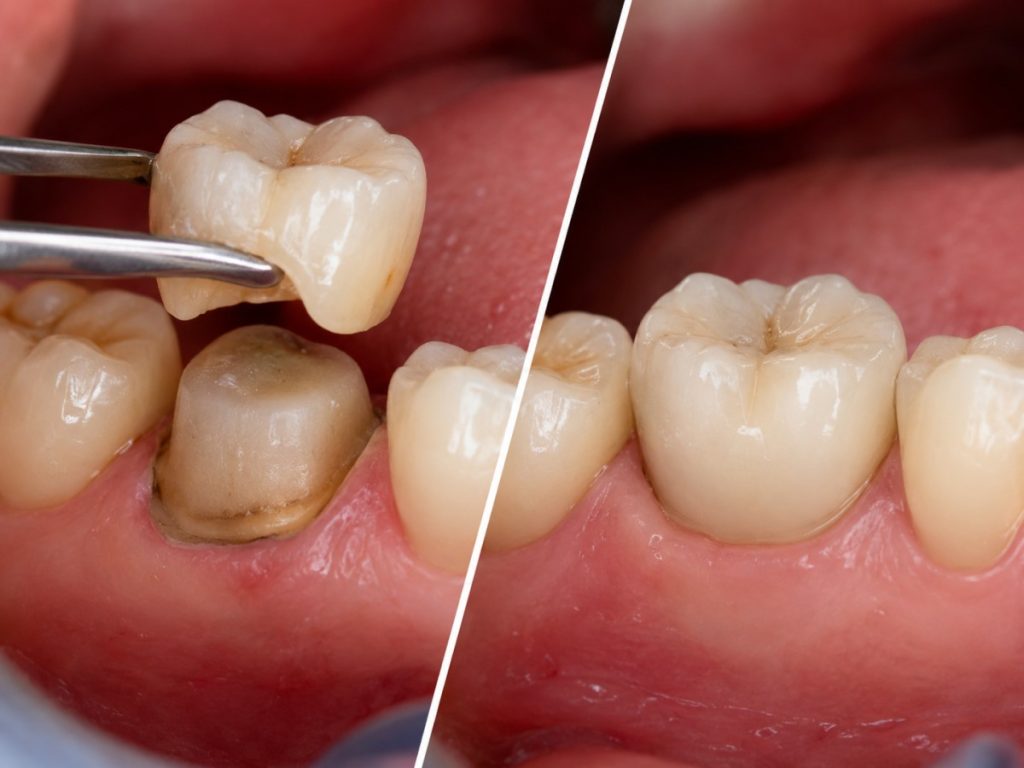
Dental crown repair is a conservative treatment that addresses limited damage while retaining most or all of the existing crown. The objective is to restore an acceptable surface, function or retention without manufacturing an entirely new restoration.
The type of repair depends on the problem.
A small chip may sometimes be smoothed, polished or restored with an appropriate dental material. A crown that has lost retention but remains structurally intact may potentially be recemented after the tooth and crown have been examined.
Repair is generally considered when the crown remains fundamentally sound.
The dentist needs to determine whether the crown still fits appropriately, whether its margins remain acceptable and whether the natural tooth underneath is healthy.
If these conditions are not present, repairing only the visible defect may not address the actual problem.
What Is Dental Crown Replacement?
Dental crown replacement involves removing the existing crown and providing a new restoration. Replacement is generally considered when the original crown can no longer adequately protect the tooth or function predictably.
The procedure normally begins with removing the old crown so the underlying tooth can be examined directly.
Any decay, damaged tooth structure or other dental condition is addressed before the replacement restoration is made.
The tooth may then require further preparation or reconstruction.
An impression or digital scan records the prepared tooth, and a temporary crown may be provided while the definitive restoration is fabricated.
The replacement crown is subsequently checked for fit, contact with neighbouring teeth and bite before it is secured.
Replacement therefore involves more extensive treatment than a limited crown repair.
Key Differences Between Repair and Replacement
The main difference between dental crown repair and replacement is how much of the existing restoration is retained.
Repair preserves the crown and addresses a specific defect. Replacement removes the existing restoration and creates a new one based on the current condition of the tooth.
| Factor | Crown Repair | Crown Replacement |
| Existing crown | Mostly retained | Removed |
| Typical damage | Minor or localised | Extensive or structural |
| Crown fit | Must generally remain acceptable | New fit is established |
| Underlying tooth | Should remain suitable | Can be treated before new crown |
| Treatment scope | More limited | More extensive |
| New crown required | Usually no | Yes |
| Suitable for major fracture | Usually limited | More likely |
| Suitable for poor crown fit | Usually no | Often considered |
Neither option is automatically better. The appropriate choice depends on whether the existing crown remains suitable for continued use.
When Is Dental Crown Repair Recommended?
Dental crown repair may be recommended when the problem is limited enough that the existing restoration can still provide appropriate protection and function.
The dentist considers the size and location of the damage, crown material, condition of the margins and health of the supporting tooth.
Small Crown Chips
A small chip may sometimes be repaired when the defect does not compromise the overall strength of the crown.
Minor roughness may only require smoothing or polishing.
Other localised defects may be restored using a suitable dental material, depending on the type of crown and location of the damage.
The bite should also be assessed because excessive contact may have contributed to the chip.
Repairing the surface without addressing repeated heavy forces could allow the problem to recur.
Minor Surface Damage
Limited surface wear or damage may be managed conservatively if the crown remains structurally sound.
The dentist needs to determine whether the visible defect is genuinely superficial.
Some cracks that initially appear small can extend more deeply through the restoration.
Clinical examination is therefore necessary before assuming that a minor-looking defect is suitable for repair.
An Intact Loose Crown
A loose crown may sometimes be retained if it remains undamaged and continues to fit the prepared tooth correctly.
The dentist can remove or retrieve the crown, examine the underlying tooth and determine why retention was lost.
If the tooth is healthy and the crown remains suitable, professional recementation may be possible.
However, a loose crown should not automatically be recemented without assessment.
Decay, changes in the prepared tooth or crown damage can also cause loss of retention.
When Is Dental Crown Replacement Recommended?
Dental crown replacement is more likely when the existing restoration has substantial structural damage or when problems involving the underlying tooth prevent predictable repair.
Replacement also allows the dentist to redesign the restoration when the original crown no longer fits appropriately.
Significant Crown Fracture
A significantly fractured crown may not have enough remaining structural integrity for a localised repair.
A large fracture can alter the shape, bite and strength of the restoration.
Even if the missing section can technically be rebuilt, the repair may not provide the same predictable function as a new crown.
The dentist considers how much crown material remains and where the fracture is located before making this decision.
Extensive Cracks
A cracked crown may require replacement when the crack extends substantially through the restorative material.
The dentist also needs to determine whether the natural tooth underneath has been affected.
If the tooth itself is cracked, treatment depends on the location and extent of that fracture.
Replacing the crown alone will not resolve a structural problem involving the supporting tooth.
Poor Crown Fit
A crown that no longer fits correctly is generally difficult to manage through surface repair.
Accurate fit is important because the restoration needs to protect the prepared tooth while allowing the margins to be maintained.
A poorly fitting crown can create areas where plaque and food debris accumulate.
If the crown-to-tooth relationship has changed substantially, a new restoration may be required.
Extensive Crown Wear
Dental crowns can gradually wear because of normal function or excessive forces such as grinding and clenching.
Limited wear does not automatically require replacement.
However, extensive wear can affect the crown’s shape, thickness and bite.
Replacement may be considered when the remaining restoration can no longer provide appropriate coverage or function.
How Underlying Decay Changes the Decision

Decay beneath a dental crown can make replacement more likely because the natural tooth needs to be treated before the restoration can continue functioning.
A crown itself cannot develop dental decay, but the tooth underneath remains susceptible.
Decay can begin around the crown margin and progress beneath the restoration.
When this occurs, simply repairing a visible chip or recementing the crown may leave the underlying disease untreated.
The crown may need to be removed so the dentist can access the affected area.
After decay is removed, the remaining healthy tooth structure is assessed. If sufficient structure remains, the tooth may be rebuilt and prepared for another crown.
The extent of the decay therefore influences both whether the original crown can be retained and whether the tooth remains suitable for restoration.
What if the Tooth Needs Root Canal Treatment?
A crowned tooth may require root canal treatment when the dental pulp becomes irreversibly inflamed, infected or non-vital. This diagnosis is separate from whether the crown itself is damaged.
Root canal treatment does not automatically require crown replacement.
In selected cases, treatment can be performed through an access opening made in an existing crown. The opening is then appropriately restored after the root canal procedure.
However, replacement may be considered if the crown is already damaged, poorly fitting or associated with significant decay.
The treatment decision should therefore consider the condition of both the crown and the tooth.
What if the Crown Keeps Becoming Loose?
Repeated crown looseness suggests that the underlying cause needs to be identified before further recementation is attempted.
Loss of dental cement is one possible explanation, but it is not the only one.
Recurrent looseness may also be associated with:
- Decay underneath the crown
- Insufficient remaining tooth structure
- Changes in crown fit
- Excessive biting forces
- Structural damage to the restoration
If the crown and tooth remain suitable, recementation may still be possible.
If the restoration no longer fits predictably or the tooth has changed substantially, replacement may provide a more appropriate solution.
Does Crown Material Affect the Decision?
Crown material can influence whether a particular type of damage can be repaired predictably.
Ceramic, porcelain-based and zirconia restorations have different physical and bonding characteristics.
A small surface defect in one material may be managed differently from a similar-looking defect in another.
The location of the damage also matters.
A repair exposed to substantial chewing forces may have different requirements from one in a lower-stress area.
The dentist therefore considers the crown material together with the extent of damage, tooth position and bite rather than making the decision based on material alone.
Does Crown Age Determine Whether It Should Be Replaced?
Crown age alone does not determine whether repair or replacement is necessary.
An older crown that remains stable, well fitted and supported by a healthy tooth may continue to function.
Conversely, a relatively new crown may require replacement if it becomes significantly fractured or the underlying tooth develops a serious problem.
Replacing a crown also involves additional treatment to the natural tooth.
For this reason, removing a clinically satisfactory restoration simply because it has reached a particular age may not provide a meaningful benefit.
The crown’s current clinical condition is more important than its age alone.
Making the Right Treatment Decision
The decision between crown repair and replacement is based on whether retaining the existing restoration can provide a predictable and maintainable result.
The dentist generally evaluates several factors before recommending treatment.
1. Extent of Damage
Small and localised defects are more compatible with repair. Large fractures or extensive cracks make replacement more likely.
2. Condition of the Crown Margins
The margins should continue to fit the prepared tooth appropriately. Surface repair cannot correct a fundamentally poor crown-to-tooth relationship.
3. Health of the Natural Tooth
Decay, cracks and loss of tooth structure can make replacement necessary even if the visible crown appears relatively intact.
4. Stability of the Crown
A repeatedly loose restoration requires investigation into why retention is failing.
5. Patient’s Bite
Heavy or abnormal contacts can contribute to repeated crown damage. Addressing the bite may be relevant before repairing or replacing the restoration.
6. Long-Term Maintainability
The chosen treatment should allow the crown margins and surrounding tooth to be cleaned and monitored. A repair that creates difficult-to-maintain contours may not be appropriate simply because it avoids immediate replacement.
Is Repair Always Better Because It Is More Conservative?
Repair is more conservative when it can preserve a functional restoration without compromising the underlying tooth. However, conserving an unsuitable crown is not necessarily beneficial.
A localised repair makes sense when the remaining restoration is healthy and predictable.
Repeatedly repairing a crown with major structural damage or poor fit can delay more appropriate treatment.
Replacement is more extensive because the existing crown must be removed and another restoration fabricated.
However, it also allows the dentist to treat underlying problems and create a crown that reflects the tooth’s current condition.
The goal should therefore be appropriate preservation rather than automatically choosing the least extensive procedure.
What Happens if Crown Treatment Is Delayed?
Delaying treatment can allow some crown problems to become more extensive, particularly when the natural tooth is exposed or decay is present.
A minor cosmetic defect may not carry the same urgency as a loose crown with underlying decay.
A fractured restoration can expose vulnerable tooth structure to additional mechanical forces.
Decay can also progress further beneath a crown.
If bacteria reach the dental pulp, inflammation or infection can develop and additional treatment may become necessary.
Prompt assessment does not mean that every damaged crown requires immediate replacement. It allows the condition to be diagnosed before deciding whether monitoring, repair or replacement is appropriate.
Frequently Asked Questions (FAQs)
Is it better to repair or replace a dental crown?
Neither option is universally better. Repair may be appropriate for minor damage when the crown remains sound, while replacement may be necessary for significant fractures, poor fit or underlying tooth problems.
Can a cracked dental crown be repaired?
A small superficial defect may sometimes be repairable, depending on the crown material and location. A significant crack affecting structural integrity is more likely to require replacement.
Can a loose crown be repaired without replacing it?
An intact loose crown may sometimes be recemented if it still fits correctly and the underlying tooth remains healthy. The reason for the looseness should be identified first.
Can a chipped porcelain or ceramic crown be repaired?
Some limited chips can potentially be smoothed, polished or repaired. The size and position of the chip, crown material and biting forces influence whether this is appropriate.
Does decay under a crown mean it must be replaced?
Not in every situation, but decay extending beneath a crown often requires the restoration to be removed so the tooth can be properly treated. Whether the original crown can be reused depends on its condition and the resulting shape of the tooth.
Can an old crown be repaired rather than replaced?
Yes, if the crown remains structurally sound and well fitted and the problem is suitable for repair. Age alone does not prevent a crown from being retained.
What happens if the natural tooth is cracked under the crown?
Treatment depends on the location and severity of the tooth crack. Some cracked teeth may remain treatable, while more extensive fractures can significantly affect the prognosis. The crown and underlying tooth need to be assessed together.
Choosing Treatment Based on the Crown and the Tooth
Dental crown repair vs replacement is not simply a choice between a smaller and larger procedure. The decision depends on whether the existing restoration can continue protecting the natural tooth after the identified problem has been treated.
Minor chips, surface defects and selected cases of crown looseness may be manageable without complete replacement. Significant fractures, poor fit, recurrent problems or extensive underlying decay are more likely to require a new restoration.
The natural tooth remains central to the decision. Evaluating the crown, tooth structure, margins and bite together provides a more reliable basis for deciding whether repair or replacement is appropriate.
Determine the Right Approach for Your Damaged Crown
If your crown is cracked, chipped, loose or causing discomfort and you are unsure whether it should be repaired or replaced, book a consultation with Dr. Seah’s Root Canal Clinic today. A dental assessment can evaluate the restoration and underlying tooth and determine whether conservative crown repair or complete crown replacement is appropriate.
