


A knocked out tooth is a time-sensitive dental emergency, particularly when a permanent tooth has been completely displaced from its socket. Immediate first aid and prompt assessment by an emergency dentist can influence whether tooth reimplantation is possible and the tooth can potentially be preserved.
A tooth that has been completely knocked out is known clinically as an avulsed tooth. Dental avulsion can occur during sports, falls, road accidents, physical impacts or other forms of dental trauma.
What happens immediately after the injury matters. The tooth should be handled carefully by its crown rather than its root, unnecessary cleaning or scraping should be avoided, and the tooth should not be allowed to dry out while emergency dental treatment is being arranged.
A knocked-out baby tooth and a knocked-out permanent tooth also require different management. Primary teeth should generally not be replanted because this can affect the developing permanent tooth underneath.
Key Takeaways
A knocked-out permanent tooth requires urgent professional dental attention because the tissues on the root surface can deteriorate when the tooth remains outside its socket.
Important points include:
- A completely displaced tooth is called an avulsed tooth.
- A knocked-out permanent tooth is a dental emergency.
- Handle the tooth by the crown rather than the root.
- Do not scrub or scrape the root surface.
- Prevent the tooth from drying out unnecessarily.
- Seek emergency dental treatment immediately.
- Do not attempt to replant a knocked-out baby tooth.
- A dentist must assess whether reimplantation is appropriate.
- Follow-up care is necessary even when the tooth has been successfully repositioned.
- Dental trauma can also damage surrounding teeth, gums and bone.
Rapid action does not guarantee that a permanent tooth can be saved, but unnecessary delays can reduce available treatment options.
What Is a Knocked-Out Tooth?
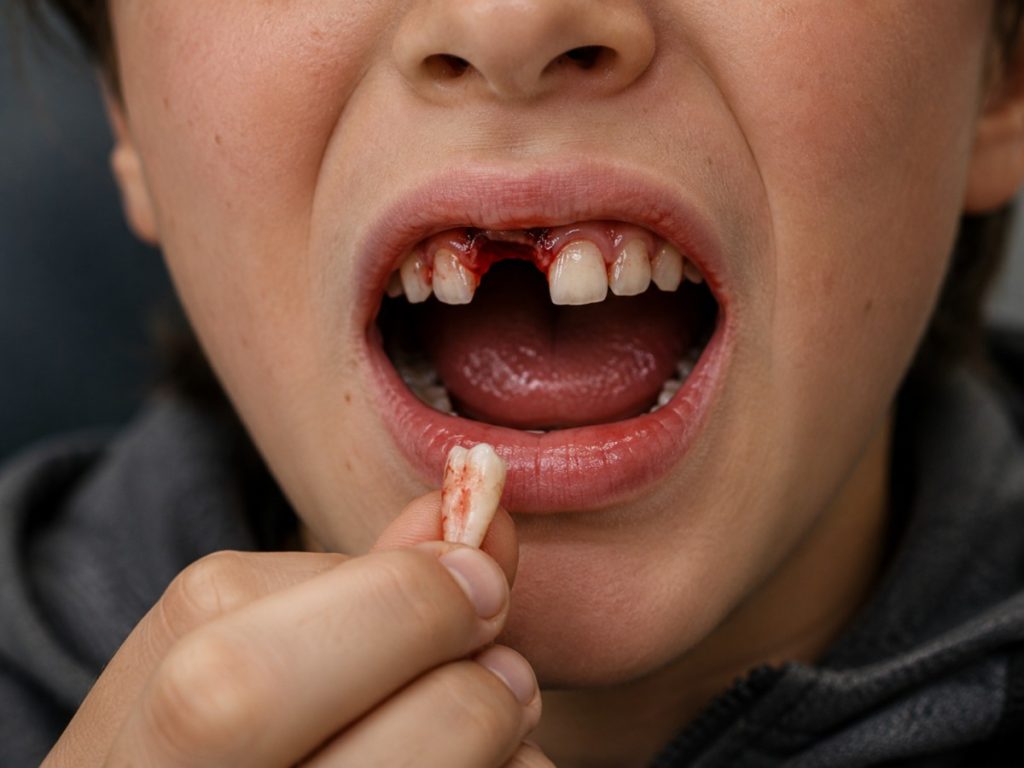
A knocked-out tooth is a tooth that has been completely displaced from its socket following dental trauma. Dentists refer to this injury as tooth avulsion.
Avulsion differs from a tooth that is merely loose or partially displaced. In an avulsion injury, the entire tooth, including its root, has left the socket.
The injury affects more than the visible tooth. The periodontal ligament, which contains specialised tissues that normally help attach the tooth to surrounding bone, is also disrupted.
These tissues are one reason careful handling is important after an injury.
Touching, scraping or aggressively cleaning the root can cause additional damage to the cells remaining on its surface.
What Commonly Causes a Tooth to Be Knocked Out?
A tooth can be knocked out when a strong force is transmitted directly to the mouth or jaw.
Front permanent teeth are particularly vulnerable because of their position.
Common situations associated with tooth avulsion include:
- Contact sports and recreational activities
- Falls and accidental impacts
- Road or cycling accidents
- Collisions involving the face or mouth
- Other forms of significant dental trauma
The impact can also injure the lips, gums, jawbone and neighbouring teeth.
For this reason, an emergency assessment should consider the entire injured area rather than only the missing tooth.
Why Is a Knocked-Out Permanent Tooth an Emergency?
A knocked-out permanent tooth is an emergency because the possibility and outcome of reimplantation can be affected by how the tooth is handled and how long it remains outside the socket.
The periodontal ligament cells on the root surface are particularly important.
Prolonged dry storage can damage these cells and influence healing after reimplantation.
The dentist also needs to assess the socket and surrounding structures.
There may be fractures, soft-tissue injuries or damage to adjacent teeth that are not immediately obvious.
Prompt emergency dental care therefore has two objectives: assessing whether the avulsed tooth can be replanted and identifying other injuries caused by the trauma.
Immediate First Aid Steps
First aid for a knocked-out permanent tooth focuses on protecting the tooth and reaching an emergency dentist as quickly as possible.
The response should be organised and gentle rather than attempting extensive treatment at the scene.
1. Confirm Whether the Tooth Is Permanent
The first step is determining whether the knocked-out tooth is a permanent or primary tooth.
Permanent teeth may potentially be candidates for reimplantation.
A knocked-out baby tooth should generally not be placed back into its socket because doing so could damage the developing permanent tooth.
If there is uncertainty, seek urgent professional advice rather than forcing the tooth back into place.
2. Pick Up the Tooth by the Crown
Hold an avulsed tooth by its crown, which is the normally visible part used for biting.
Avoid touching the root.
The root surface contains tissues important to healing after reimplantation.
Handling the root unnecessarily can damage these delicate structures.
3. Do Not Scrub the Tooth
A knocked-out tooth should not be scrubbed, scraped or disinfected using household cleaning products.
Even when the tooth looks dirty, aggressive cleaning can damage the root surface.
Do not attempt to remove tissue that appears to be attached to the root.
If cleaning is necessary, it should be done gently according to appropriate first-aid guidance rather than treating the tooth like an ordinary object that needs to be sterilised.
4. Prevent the Tooth From Drying Out
A permanent tooth that may be suitable for reimplantation should not be allowed to remain dry unnecessarily.
Drying can adversely affect the periodontal ligament cells on the root.
Appropriate storage is therefore important when immediate reimplantation is not possible.
The objective is not simply to keep the tooth physically intact but to protect the biological tissues associated with the root.
5. Seek Emergency Dental Care Immediately
Contact an emergency dentist and explain that a permanent tooth has been completely knocked out.
This information helps the clinic understand that the injury is time-sensitive.
Bring the tooth with you if it has not been replanted.
Do not wait to see whether pain or bleeding improves before seeking treatment.
The absence of severe pain does not make an avulsed permanent tooth less urgent.
Should You Put a Knocked-Out Tooth Back Into the Socket?
Immediate reimplantation of a permanent tooth may be appropriate in some circumstances, but it must be distinguished clearly from replanting a baby tooth or forcing a damaged tooth into an uncertain position.
If a permanent tooth is replanted as part of appropriate first aid, it should be handled only by the crown and placed gently into its correct orientation without unnecessary force.
However, circumstances can make immediate reimplantation inappropriate or impractical.
If there is uncertainty about whether the tooth is permanent, significant associated trauma, inability to position the tooth safely or another concern, urgent dental care should be prioritised while the tooth is stored appropriately.
A primary tooth should not generally be replanted.
How Should a Knocked-Out Tooth Be Stored?
When a knocked-out permanent tooth cannot be immediately replanted, appropriate temporary storage helps prevent the root surface from drying.
The ideal approach depends on what is safely available at the scene.
The tooth should not simply be wrapped in dry tissue or left exposed to air.
Suitable emergency storage media may be used according to established dental trauma first-aid guidance. Milk is commonly used as a practical temporary option when an appropriate specialised tooth-preservation medium is unavailable.
The tooth should still be brought to an emergency dentist immediately.
Storage is a temporary measure and does not make the situation safe to delay for several hours.
What Not to Do
Incorrect handling can damage an avulsed tooth and potentially reduce the prospects for favourable healing.
Several actions should be avoided.
Do Not Hold the Tooth by the Root
The root contains delicate periodontal ligament tissues. Hold the tooth by its crown whenever possible.
Do Not Scrub the Root
Visible dirt does not justify aggressive scrubbing. Scraping or brushing the root can remove tissues important to healing.
Do Not Use Household Disinfectants
Alcohol, bleach, cleaning products and similar substances should never be applied to an avulsed tooth. These substances can damage biological tissues.
Do Not Let the Tooth Dry Out
Wrapping the tooth in dry tissue and leaving it exposed can adversely affect root-surface cells.
Appropriate moist storage should be used when immediate reimplantation is not possible.
Do Not Replant a Baby Tooth
A primary tooth should generally not be pushed back into its socket. Replantation can potentially harm the developing permanent successor underneath.
Do Not Delay Because the Pain Is Manageable
Pain severity does not determine the urgency of tooth avulsion. A patient may have manageable discomfort while the injury remains highly time-sensitive.
What if You Cannot Find the Knocked-Out Tooth?
A missing tooth after dental trauma still requires professional assessment even when the tooth itself cannot be found.
The dentist needs to determine whether the tooth was completely avulsed, fractured or displaced into another position.
Associated soft-tissue injuries should also be assessed.
Depending on the circumstances of the accident, additional medical evaluation may be required.
This is particularly relevant after substantial facial trauma, loss of consciousness or suspected injury involving structures beyond the teeth.
Emergency Treatment for a Knocked-Out Tooth

Emergency treatment begins with assessment of the avulsed tooth, socket and surrounding oral structures.
The dentist considers factors such as whether the tooth is permanent, how it was stored, how long it remained outside the mouth and whether associated injuries are present.
Assessment of the Tooth and Socket
The dentist examines the socket and surrounding tissues for damage.
Neighbouring teeth are also assessed because the impact may have caused cracks, displacement or pulp injuries.
Dental imaging may be required to evaluate surrounding structures and rule out additional trauma.
The medical and dental history can also affect management.
Tooth Reimplantation
Tooth reimplantation means returning an avulsed permanent tooth to its socket.
Whether reimplantation is appropriate and its expected outcome depend on the circumstances of the injury.
The tooth may need to be gently repositioned and the socket appropriately managed.
Successful physical replacement of the tooth does not mean treatment is complete.
The supporting tissues require healing, and the dental pulp may also require further management.
Stabilisation With a Dental Splint
A replanted tooth commonly requires stabilisation while the periodontal tissues heal.
A dental splint connects the injured tooth to nearby teeth for a defined period.
The purpose is to provide sufficient stability while allowing appropriate healing.
The type and duration of splinting depend on the injury and associated damage.
Patients should follow the dentist’s instructions regarding eating, cleaning and follow-up while the splint is present.
Is Root Canal Treatment Needed After Tooth Reimplantation?
Root canal treatment may be required after reimplantation of an avulsed permanent tooth, depending on factors including root development and the nature of the injury.
The dental pulp’s blood supply is disrupted when a tooth is completely avulsed.
In many mature permanent teeth, this can lead to pulp necrosis and create a need for endodontic treatment.
Management can differ in immature permanent teeth because their roots and pulp have different healing potential.
An endodontist or treating dentist determines whether root canal treatment is required and the appropriate timing based on the individual injury.
Follow-up should not be skipped simply because the replanted tooth initially feels comfortable.
Why Follow-Up Care Is Important
Follow-up care is essential because complications after tooth avulsion can develop after the initial emergency has been managed.
A replanted tooth needs to be monitored clinically and, where appropriate, radiographically.
The dentist evaluates healing of the supporting tissues, pulp status, root condition and tooth stability.
Possible complications can include infection-related problems and changes affecting the tooth root or surrounding bone.
Some complications may initially produce few noticeable symptoms.
Regular monitoring allows changes to be identified and managed as appropriate.
Can a Knocked-Out Tooth Always Be Saved?
A knocked-out permanent tooth cannot always be successfully preserved, even when first aid and emergency treatment are provided promptly.
The prognosis depends on several biological and injury-related factors.
Important considerations include the amount of time the tooth remained outside the socket, whether it was kept dry, how the root was handled, root development and associated damage.
Prompt treatment improves the available management opportunities but cannot guarantee long-term tooth survival.
When reimplantation is not possible or does not provide a sustainable result, the dentist can discuss appropriate options for managing the missing tooth.
What Happens if the Tooth Cannot Be Reimplanted?
When a permanent tooth cannot be reimplanted, treatment shifts towards managing the injury and planning for the missing tooth.
The appropriate approach depends on the patient’s age, dental development, location of the missing tooth and surrounding oral structures.
Immediate replacement is not necessarily performed during the emergency appointment.
The injured tissues may first need to heal.
Longer-term tooth replacement or restorative options can then be discussed based on individual circumstances.
For younger patients whose jaws are still developing, treatment planning may differ from that for adults.
Dental Trauma Beyond the Knocked-Out Tooth
Dental trauma can affect several structures at the same time, so focusing only on the visibly missing tooth can overlook other injuries.
Neighbouring teeth may be loosened, cracked or displaced.
The gum can be torn or bruised, and fragments of tooth or other material can sometimes become embedded in soft tissue.
The supporting bone may also be injured.
Significant trauma involving the face or jaw may require assessment beyond the dental clinic.
Suspected jaw fracture, loss of consciousness, severe uncontrolled bleeding or other major injuries should receive appropriate emergency medical attention.
How to Reduce the Risk of a Knocked-Out Tooth
Not every dental injury can be prevented, but protective measures can reduce the risk during activities associated with facial impacts.
Sports are a common setting for dental trauma.
An appropriately fitted mouthguard can help protect the teeth and surrounding oral structures during relevant contact or collision activities.
General safety equipment appropriate to the activity should also be used.
Patients with protruding or vulnerable front teeth may wish to discuss individual dental trauma risks with their dentist.
Prevention cannot eliminate all accidents, but reducing direct forces to the teeth can decrease the likelihood or severity of injury.
Frequently Asked Questions (FAQs)
Is a knocked-out tooth a dental emergency?
Yes. A knocked-out permanent tooth is a time-sensitive dental emergency. Prompt first aid and professional assessment can influence whether reimplantation is possible and how the tooth heals.
How quickly should I see an emergency dentist?
Seek emergency dental care immediately after a permanent tooth has been knocked out. Do not wait for pain or bleeding to settle before arranging treatment.
Can a knocked-out tooth be put back in?
A permanent tooth may sometimes be replanted, depending on the circumstances of the injury. A knocked-out primary or baby tooth should generally not be replanted because this can affect the developing permanent tooth.
Should I wash a knocked-out tooth?
Do not scrub or aggressively clean the tooth. If the tooth is contaminated, handling should remain gentle so the root surface is not damaged.
Can I hold an avulsed tooth by the root?
Avoid touching the root. Handle the tooth by its crown because tissues remaining on the root surface are important for healing.
Can I keep a knocked-out tooth in water?
Plain water is not generally considered an ideal storage medium for preserving periodontal ligament cells. Appropriate emergency storage media, such as a specialised preservation solution where available may be preferable while urgent care is arranged.
Does a replanted tooth need root canal treatment?
Some replanted permanent teeth require root canal treatment, particularly mature teeth where the pulp is unlikely to recover after avulsion. Management depends on root development and the individual injury.
What if a child’s baby tooth is knocked out?
A knocked-out primary tooth should generally not be replanted. The child should still receive dental assessment to evaluate the socket, surrounding tissues and developing permanent teeth.
What if the knocked-out tooth does not hurt?
Lack of severe pain does not reduce the urgency. Complete tooth avulsion is time-sensitive because the viability of tissues on the root surface is affected by extra-oral conditions.
The First Response Can Influence the Treatment Options
A knocked-out permanent tooth is one of the dental emergencies where immediate action is particularly important. Correct first aid involves identifying whether the tooth is permanent, handling it by the crown, protecting the root surface and preventing unnecessary drying while emergency dental care is arranged.
Tooth reimplantation may be possible in appropriate cases, but placing the tooth back into its socket is only the beginning of treatment. Stabilisation, follow-up monitoring and sometimes root canal therapy can form part of ongoing care.
A knocked-out baby tooth requires different management and should generally not be replanted. Significant associated facial trauma may also require medical emergency assessment.
Act Promptly to Assess a Knocked-Out Permanent Tooth
If you or someone with you has suffered a knocked-out permanent tooth or other significant dental trauma, book a consultation with Dr. Seah’s Root Canal Clinic for prompt assessment. The dentist can evaluate the avulsed tooth and surrounding structures and determine whether reimplantation, stabilisation, endodontic treatment or another approach is appropriate.
